DIANA UCLM
Language: EN
Join

Who we are

The team

Four technical departments, one association and many afternoons in the Sabatini guardhouses.

The DIANA team in 2025/26

Who we are

DIANA is a student association at the University of Castilla-La Mancha that designs, builds and flies its own fixed-wing drones to compete nationally and internationally. It was founded in 2022 at the School of Industrial and Aerospace Engineering in Toledo by Pablo Zamorano, then an aerospace engineering student, and it is registered both with the Castilla-La Mancha Register of Associations and with the university itself.

The name

The initials stand for Development and Investigation in Aerospace and Navigation Areas. But the name comes, above all, from Diana Trujillo, the NASA aerospace engineer who worked on missions such as Mars Science Laboratory and Perseverance. She is the benchmark the team chose for itself.

What we do

We build electric fixed-wing drones to compete. Every academic year a new aircraft is designed, built and flown, and each one carries forward what the previous one taught: the 2024 Insomnio, almost entirely 3D-printed; the 2025 Aurora, in balsa wood and heat-shrink film; and the 2026 Eclipse, the first all-carbon-fibre aircraft, with which the team made its international debut at the Air Cargo Challenge in Stuttgart.

With the founding goal achieved —reaching the Air Cargo Challenge— the association is now looking beyond the annual competition: an in-house R&D department, several aircraft per year, and experimental lines in rocketry and FPV drones.

Where

We work in the Sabatini guardhouses, small historic buildings next to the main gate of the Fábrica de Armas campus in Toledo. They are the workshop, the office and the place where afternoons go.

Why it exists

DIANA exists because it is addictive: whoever joins wants it to keep going. You start seeing in real life what the lectures explain. Practice teaches far more than theory, and anyone studying electronics, aerodynamics or flight mechanics feels the difference between paper and an aircraft that flies, built with their own hands.

We are sixteen members from aerospace and electrical engineering at the start of the 2026/27 year, organised in four technical departments, and every September we open applications for new people to join.
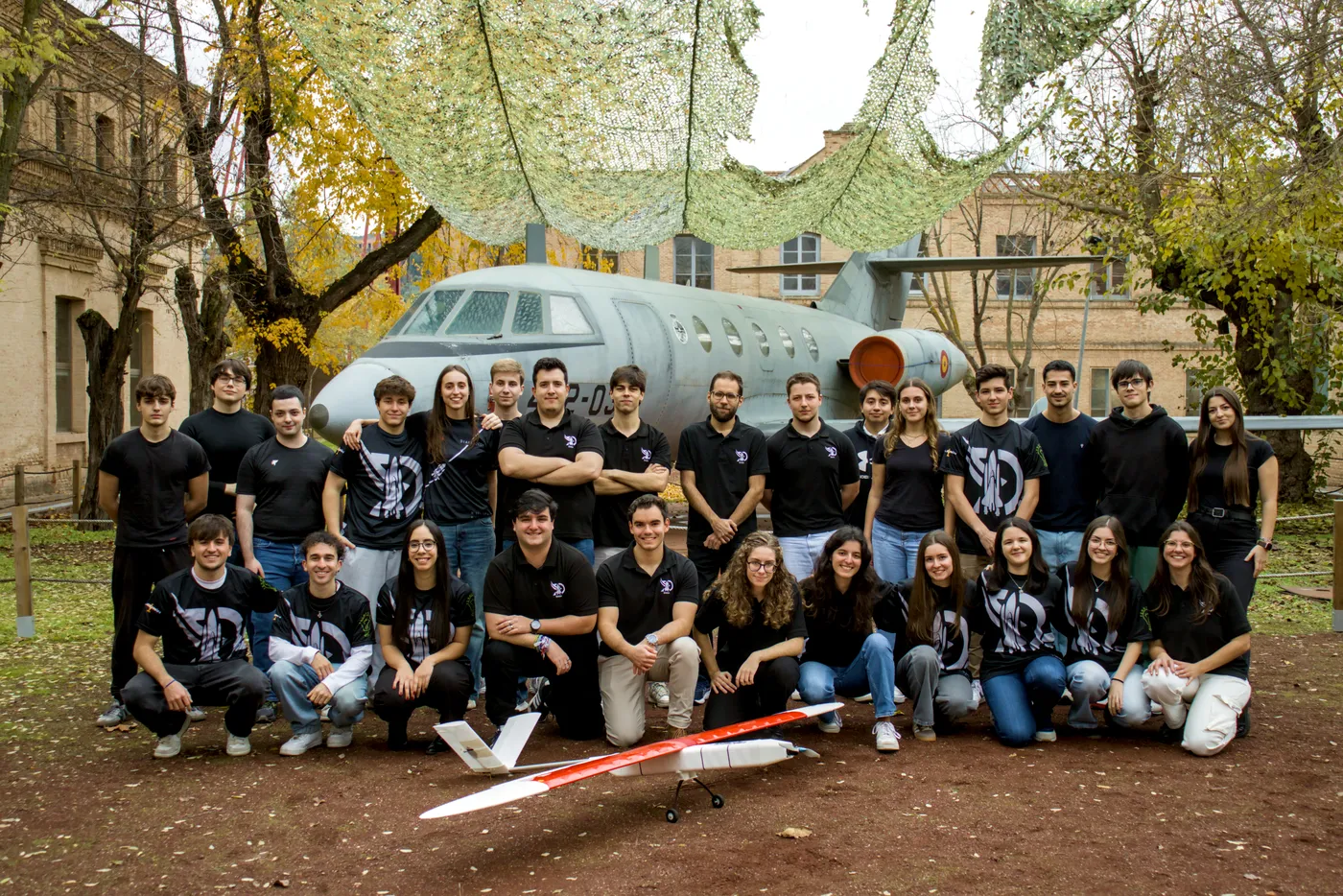
The team

The four departments

Aerodynamics

Design and simulation. Everything that happens before a single part exists.

Aerodynamics works outside the workshop. From the start of the year it researches airfoils, geometries and configurations: designing a custom airfoil or using a conventional one, elliptical or straight wing, sweep, dihedral. Once there is a main idea, several iterations of the outer geometry are designed in XFOIL and XFLR5, then refined with MATLAB and CFD simulations until one holds up on paper.

It is also the chief pilot’s department, although flying is a cross-cutting role rather than a departmental function.

Tools of the trade
  • XFOIL
  • XFLR5
  • MATLAB
  • CFD
What you learn
To turn a competition requirement into a geometry that flies, iterating between airfoils, planforms and simulation until the numbers add up.

Structures and manufacturing

Modern and traditional forming, and the proof that it holds.

When Aerodynamics releases its first iterations, Structures starts designing the internal structure and the joints, and gives it physical form. Modern techniques —composites with 3D-printed moulds and resin infusion— live alongside traditional ones such as balsa wood.

In parallel, the structures sub-department simulates the aircraft’s critical parts —landing gear, wings, fuselage— in Abaqus to check they carry their loads without over-sizing. Every year it also researches more efficient forming methods that fit the rules of the competition at hand.

Tools of the trade
  • Abaqus
  • SolidWorks
  • composites
  • balsa wood
  • 3D printing
What you learn
To go from a model to a real part that weighs what it should and does not break, and to prove it in simulation before breaking it for real.

Electronics and propulsion

Light, efficient systems, with an in-house test bench.

In electronics there is always room to improve: from a conventional receiver to ExpressLRS, from ELRS to a custom one, and from the custom one to ever cleaner code. The goal is the best control response with the lightest, most efficient system possible.

In propulsion the aim is the right balance between motor, propeller, battery and ESC, using a test bench the team built itself —thrust gauge, current, voltage and rpm sensors, PID control on an Arduino— and working alongside Aerodynamics, which needs the thrust and efficiency data to design.

Tools of the trade
  • ExpressLRS
  • flight controllers
  • Mission Planner
  • Arduino
  • in-house thrust bench
What you learn
To close the loop between motor, propeller, battery and ESC with measured data rather than catalogue figures, and to go from an off-the-shelf receiver to one you programmed yourself.

Logistics and operations

What keeps the project afloat, from the money to the social feeds.

Operations keeps the project afloat: social media, video editing, photography, events. And above all, raising the money that makes it possible, whether through events, raffles, merchandising or sponsors.

It is the department companies talk to. If you got here from a sponsor’s email, someone on this team probably wrote it.

Tools of the trade
  • sponsors
  • events
  • social media
  • video and photography
  • merchandising
What you learn
To make a technical project actually happen, with a budget, deadlines, travel and a story people want to follow.

Academic year 2026/27

Who we are this year

Coordination

  • Alejandro Pérez Guisado

    General coordinator

    4º · Grado en Ingeniería Aeroespacial

Aerodynamics · 4 members

  • Guillermo Adolfo Rego Antelo

    Department coordinator

    4º · Grado en Ingeniería Aeroespacial

  • Andreea Buruiana Buruiana

    2º · Grado en Ingeniería Aeroespacial

  • Carlos Camuñas Peces

    3º · Grado en Ingeniería Aeroespacial

  • Rosa María Martín García

    3º · Grado en Ingeniería Aeroespacial

Structures and manufacturing · 6 members

  • Carla Giribet Borràs

    Department coordinator

    3º · Grado en Ingeniería Aeroespacial

  • Ángela Párraga Seco

    3º · Grado en Ingeniería Aeroespacial

  • Eduardo Escribano García

    3º · Grado en Ingeniería Aeroespacial

  • Jose Andrés Segura Rodríguez

    2º · Grado en Ingeniería Aeroespacial

  • Pelayo Borrell Pares

    2º · Grado en Ingeniería Aeroespacial

  • Zineb Ouahbi Touil

    3º · Grado en Ingeniería Aeroespacial

Electronics and propulsion · 2 members

  • Juan Nicolás Suaza Escandón

    Department coordinator

    2º · Grado en Ingeniería Eléctrica

  • Adrián Hernández Lázaro

    2º · Grado en Ingeniería Eléctrica

Logistics and operations · 3 members

  • Aitana Fernández Martínez

    Department coordinator

    2º · Grado en Ingeniería Aeroespacial

  • Sofía Quintano Molina

    4º · Grado en Ingeniería Aeroespacial

  • Valeria Molina Molina

    2º · Grado en Ingeniería Aeroespacial

Pilot

Join

Studying at UCLM?

No experience needed. Just the will to spend your afternoons in the workshop.

How to join