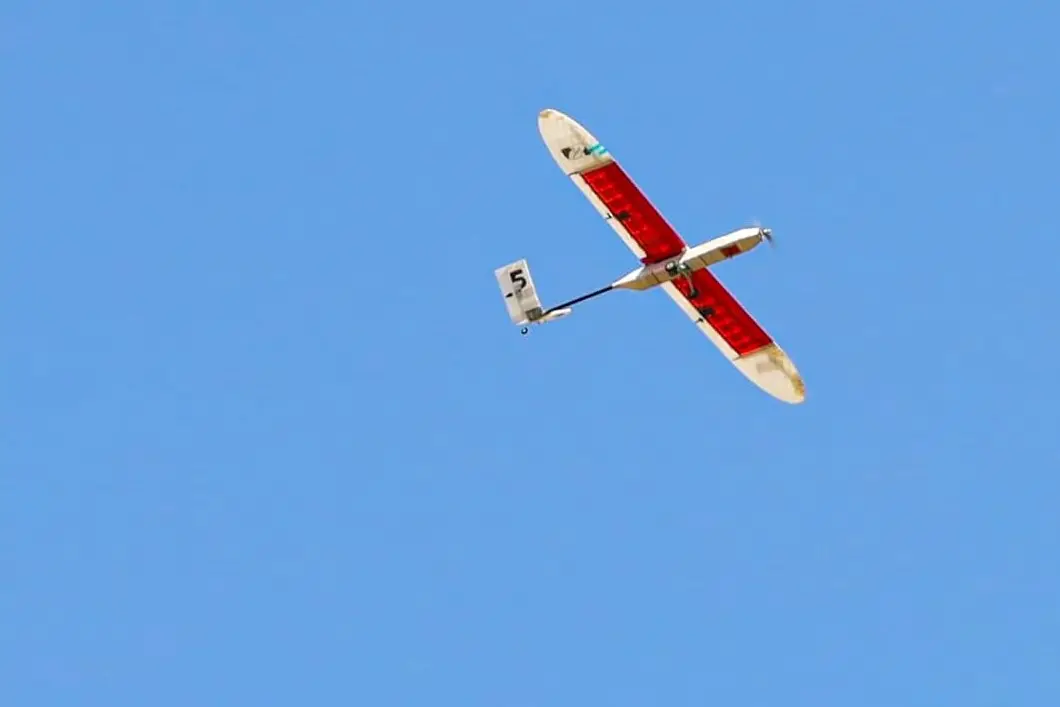
The Aurora is DIANA’s second aircraft and the one that taught the most. It flew at the XtraChallenge 2025 in Valencia and finished 13th of 15, with two awards that explain themselves once you know what happened: perseverance, and first landing.
Design
Elliptical wingtips were chosen because the team’s aerodynamics lecturer always repeated that this was the most efficient configuration. A first 750 mm section was designed fully straight, transitioning to an elliptical tip. That simplified the use of balsa wood on the straight section, finishing the tip in 3D print, which suits the more complex geometry.
The V-tail was studied and compared against conventional tails: it won on efficiency and weight, by reducing the surface in contact with the air.
The fuselage, by contrast, sacrifices aerodynamic efficiency on purpose. An almost square geometry was chosen to ease manufacturing.
Build
Manufacturing was an iterative learning process: a combination of balsa wood and 3D printing, mostly in LW-PLA, the material that defines the team’s first two aircraft.
The internal structure was first designed in WingHelper. The elliptical tip went through several joint iterations before passing the static test, which consists of lifting the aircraft by its wingtips.
For the wing-fuselage joint, a sandwich clamp gripping the two main wing rods was chosen, forming a firm connection. The tail, on the other hand, is built entirely in LW-PLA and joins the rest of the aircraft through a 20 mm carbon tube.
What went wrong and how it was fixed
The big one: the flaperon servos. The underlying causes were poor organisation and a lack of experience in electronics. The force the flaperon servos had to deliver was never calculated, and that mistake was paid in full: above a certain speed, or with a tailwind, the servos could not hold the aerodynamic load, control was lost and the aircraft ended up on the ground.
More than eight prototypes were built and every one of them crashed. The servos were not changed until Valencia, at the competition itself.
No motors at the competition. On arrival in Valencia, the team’s motors were unusable. The UVigo Aerotech team lent a new one, and with it the aircraft completed the circuit and landed. The aircraft was fine: it was the electronics that failed.
That is where the lesson worth telling comes from: critical hardware needs a chain of custody. A finished aircraft does not fly if, on competition day, a part without which no flight is possible is missing, and the motor is first on that list. To UVigo Aerotech: thank you.
Opaque Oracover. The team started with opaque red Oracover and it made work much harder: routing cables through the wing, checking the state of the structure inside. It was switched to the clear version.
The airfoil deformed. After the first flight test it became clear that the Oracover did not hold the original airfoil shape. More stringers were added to support it.
The tip failed the static test. When lifting the aircraft by the wingtips, the joint of the elliptical tip did not hold. It was solved by adding a 50 cm carbon rod running through the whole tip and part of the straight section.
Flight tests and result
More than eight prototypes built and all of them crashed, always for the same reason. The first flight test also revealed the airfoil deformation.
In Valencia, with the servos changed and the borrowed motor, the aircraft completed the circuit and landed. 13th of 15, perseverance award and first landing award.